Blog Details
The Future of Creating Smarter, Scalable & High-Performing Content
The Future of Smarter Digital Content
In today’s digital world, creating content is no longer just about writing articles or publishing social media posts. Businesses need content that is structured, searchable, scalable, personalized, and valuable to their audience.
This is where Content Engineering comes into the picture.
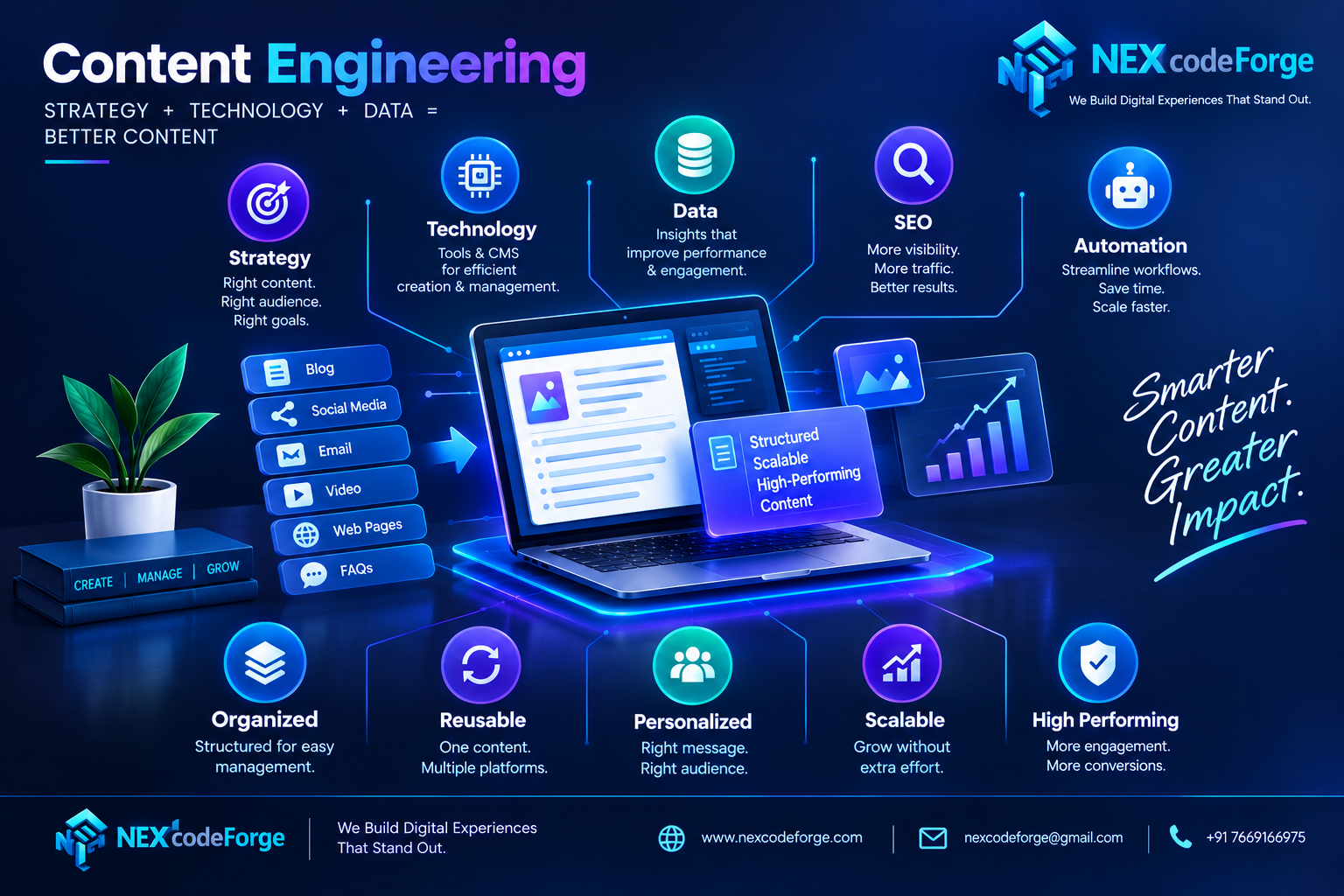
Content Engineering combines content strategy, technology, data, SEO, automation, and structured processes to create digital content that can perform effectively across different platforms.
What Is Content Engineering?
Content Engineering is the process of designing, organizing, creating, managing, and optimizing content using a combination of technology and strategic content practices.
Instead of treating every piece of content as a separate task, Content Engineering creates a system where content can be:
- Created efficiently
- Reused across multiple platforms
- Optimized for search engines
- Organized systematically
- Personalized for different audiences
- Updated easily
- Scaled as the business grows
For example, a single long-form article can be transformed into website content, social media posts, email content, short videos, FAQs, and other digital assets.
Why Is Content Engineering Important?
Businesses are producing more content than ever before. However, simply producing more content does not guarantee better results.
Content Engineering helps businesses build a repeatable and scalable content system.
Some major benefits include:
1. Better Content Organization
A structured content system makes it easier to manage large amounts of information.
Content can be categorized using topics, keywords, tags, content types, customer segments, and other useful attributes.
2. Improved SEO Performance
Content Engineering can support SEO by creating structured content around relevant topics and search intent.
Businesses can organize content around:
- Primary keywords
- Secondary keywords
- Search intent
- Topic clusters
- Internal linking
- Metadata
- Structured content
This can make content easier for both users and search engines to understand.
3. Content Reusability
One of the biggest advantages of Content Engineering is content reuse.
For example, a detailed blog can become:
Blog → LinkedIn Post → Instagram Carousel → Email → Video Script → FAQ
This allows businesses to get more value from the same content investment.
4. Faster Content Production
With clearly defined workflows, templates, automation, and content management systems, teams can reduce repetitive manual work.
This allows content teams to spend more time on strategy, creativity, and quality.
5. Consistent Brand Communication
A well-designed content system helps maintain consistency across websites, social media, email campaigns, and other digital channels.
Consistent messaging can help businesses build a stronger digital identity.
Key Elements of Content Engineering
A successful Content Engineering strategy usually includes several important components.
Content Strategy
The first step is understanding what content needs to be created and why.
Businesses should identify:
- Target audience
- Business goals
- Customer needs
- Content topics
- Search intent
- Distribution channels
Content Architecture
Content architecture defines how information is structured and connected.
For example, a website might organize content into:
Services → Service Pages → Industry Solutions → Blogs → FAQs
A clear structure makes information easier to navigate and manage.
SEO & Keyword Strategy
Search engine optimization is an important part of Content Engineering.
Content should be created around relevant search queries while maintaining natural, useful, and readable information.
Content Management Systems
CMS platforms allow businesses to create, organize, update, and publish content efficiently.
A well-structured CMS can also make content easier to reuse across different parts of a digital ecosystem.
Automation
Automation can help streamline repetitive content processes such as:
- Content workflows
- Publishing
- Metadata management
- Content distribution
- Reporting
- Updates
Automation should support human creativity rather than simply producing large quantities of low-quality content.
Data & Analytics
Content performance should be measured using data.
Businesses can track metrics such as:
- Organic traffic
- Engagement
- Conversion rate
- Click-through rate
- Keyword performance
- User behavior
These insights can be used to continuously improve the content strategy.
Content Engineering vs Traditional Content Creation
Traditional content creation often focuses on producing individual pieces of content.
Content Engineering focuses on building a complete content ecosystem.
| Traditional Content Creation | Content Engineering |
|---|---|
| Individual content pieces | Connected content system |
| Manual processes | Structured workflows |
| Limited reuse | High content reusability |
| Content-focused | Content + technology |
| Short-term production | Long-term scalability |
| Basic optimization | Data-driven optimization |
How AI Is Changing Content Engineering
Artificial Intelligence is becoming an important part of modern content workflows.
AI tools can assist with:
- Topic research
- Content ideas
- Keyword analysis
- Content outlines
- Personalization
- Content transformation
- Summarization
- Workflow automation
- Performance analysis
However, human expertise remains important for accuracy, originality, brand voice, strategy, and quality control.
The most effective approach is often a combination of AI + human expertise + structured processes.
How Businesses Can Implement Content Engineering
Businesses can start with a simple step-by-step approach:
Step 1: Define your goals
Understand what you want your content to achieve.
Step 2: Understand your audience
Identify their questions, problems, interests, and search behavior.
Step 3: Build a content structure
Create categories, topics, content types, and relationships between them.
Step 4: Develop reusable content formats
Create templates that can be used repeatedly.
Step 5: Integrate SEO
Optimize content for relevant keywords and search intent.
Step 6: Use technology and automation
Automate repetitive processes where appropriate.
Step 7: Measure performance
Track results and improve your content based on data.
The Future of Content Engineering
As businesses continue to use websites, mobile applications, SaaS platforms, social media, AI, and other digital channels, the amount of content they manage will continue to increase.
Content Engineering provides a structured approach to managing this complexity.
The future of digital content is not simply about creating more content. It is about creating better systems for creating, managing, distributing, and optimizing content.
Conclusion
Content Engineering brings together content, technology, SEO, data, automation, and strategy to create a scalable digital content ecosystem.
For businesses looking to improve their online presence, a well-engineered content strategy can help make content more organized, reusable, discoverable, and measurable.
At NexCodeForge, we help businesses build modern digital experiences through website development, SaaS and web applications, SEO optimization, UI/UX design, mobile app development, and custom software solutions.
Build smarter. Scale faster. Create digital experiences that stand out.
NexCodeForge
We Build Digital Experiences That Stand Out.
🌐 www.nexcodeforge.com
📧 nexcodeforge@gmail.com
📞 +91 7669166975
Leave a Reply
Your email address will not be published.